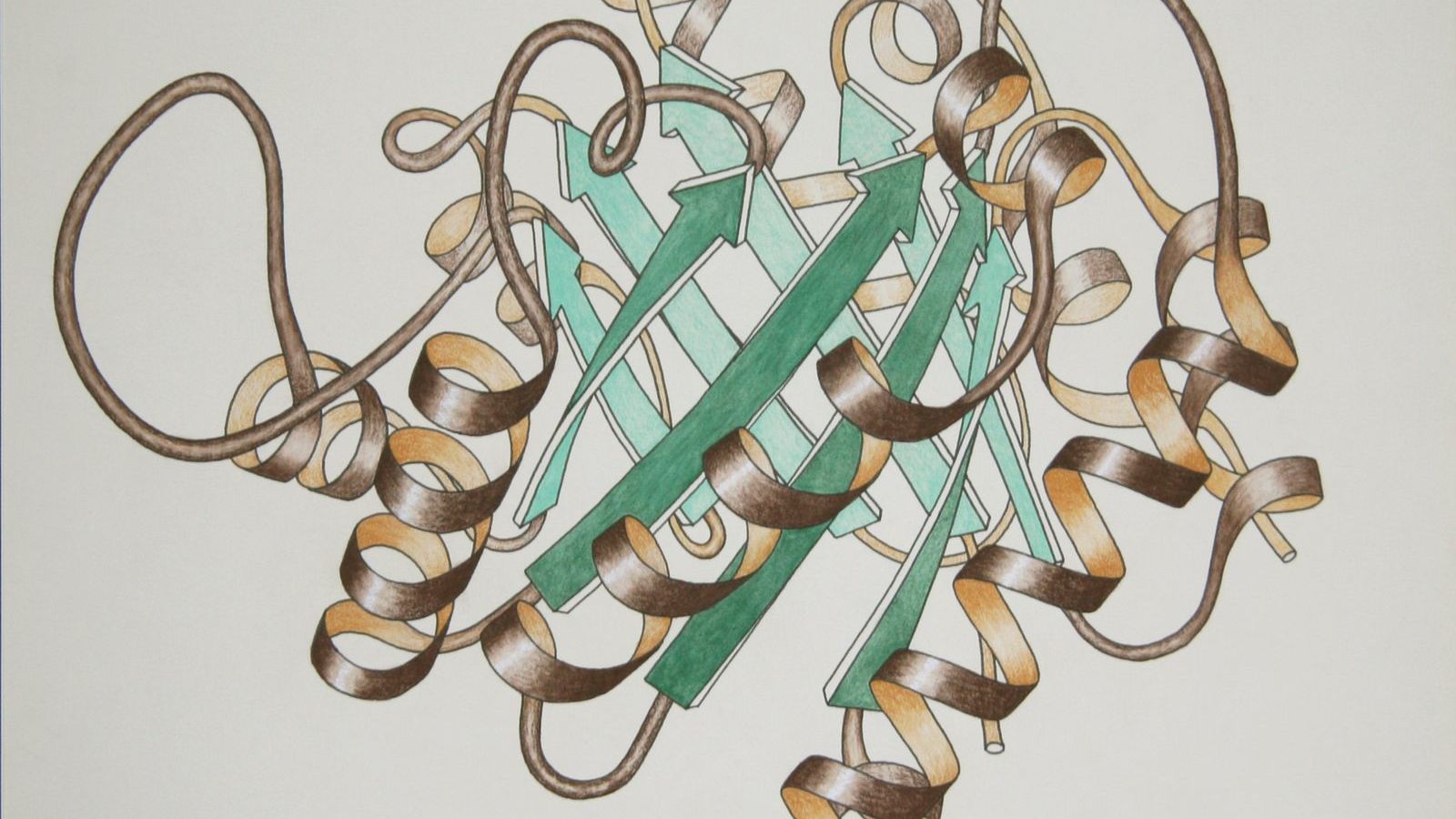
 Image: Jane Richardson (CC BY 3.0)
How AlphaFold predicts the shape of a protein
A protein is a chain of amino acids, between a few dozen and a few thousand of them from an alphabet of twenty, and the chain folds into a three-dimensional shape within milliseconds of being made. The shape is what the protein does: an enzyme's pocket fits its target, an antibody's surface matches its antigen, a channel's pore lets one ion through and not another. The chain is cheap to read; the human genome gave us 20,000 of them. The shape, until 2020, took a laboratory months or years to measure by X-ray crystallography, and about 170,000 had been measured in sixty years. The question of whether the shape could be computed from the chain was posed in the 1960s and was, by 2020, the oldest open problem in computational biology.
The competition
Since 1994 the field had measured its progress with CASP, the Critical Assessment of protein Structure Prediction, a blind test held every two years. Laboratories that had just solved a structure but not yet published it submit the sequence; the predicting groups send in their shapes; the organizers compare. The score, called GDT, is the percentage of the chain's atoms that a prediction places within a given distance of the truth, and a score of 90 is considered equivalent to an experimental measurement. For twenty years the best groups scored around 40 on the hard targets. In 2018 the first AlphaFold scored about 60. In the fourteenth CASP, in November 2020, AlphaFold 2 scored a median of 92.4 across all targets, and on the hard targets about 87.
The same result in a different unit: the median error in the position of the backbone atoms was 0.96 ångströms, where the next best group's was 2.8. A carbon atom is about 1.4 ångströms across. The predictions were, on most targets, as accurate as the experiment they were compared with. The CASP organizers said the problem was, to a first approximation, solved.
What the network does
AlphaFold 2 takes two inputs. The first is the sequence. The second is a multiple sequence alignment: the same protein's sequence as it appears in hundreds or thousands of other species, found by searching the public genome databases, lined up position by position. The alignment carries evolutionary information. If two positions far apart in the chain are close together in the folded shape, a mutation at one is often compensated by a mutation at the other, and such pairs of positions change together across species. The idea that these correlations reveal contacts was known from the 1990s and had been made to work by 2011; AlphaFold 2 made the network learn to extract them.
The main body of the network, called the Evoformer, is a stack of 48 transformer-like blocks that carry two representations: one of the alignment (every sequence, every position) and one of the pairs of positions (for every two residues, a vector that will become their distance and angle). Attention runs along the rows and columns of the alignment and across the pair representation, and the two representations update each other at every block, so that a pattern seen in the alignment sharpens a pair estimate and a confident pair estimate changes which parts of the alignment to attend to. The attention is the mechanism of the article on attention, with a twist for the pairs: when deciding whether residues i and j are close, the block also looks at i's relation to k and k's relation to j, which is the geometry of a triangle built into the architecture.
A final part of the network, the structure module in the paper's terms, turns the pair representation into coordinates: each residue is a small rigid frame, and the network predicts where every frame sits in space and rotates them together, with the atoms' positions refined through several passes of the whole network. The output includes, for every residue, a confidence score, and the confidence turned out to be well calibrated: where the network said it was unsure, usually at flexible loops, it was usually wrong, and where it said it was sure it was usually right.
What came of it
In July 2021 DeepMind and the European Bioinformatics Institute released predicted structures for the whole human proteome, and in 2022 for more than 200 million proteins, nearly every sequence in the public databases, in the AlphaFold Protein Structure Database, free to anyone. A structural biologist who used to wait a year for a structure now downloads a prediction and uses the year to test it. The predictions have been used to search for enzymes that break down plastics, to study the proteins that the malaria parasite uses to enter cells, and to make the starting models that crystallographers use to solve the structures they still measure.
On 9 October 2024 the Nobel Prize in Chemistry was awarded with one half to David Baker of the University of Washington, for computational protein design, and the other half jointly to Demis Hassabis and John Jumper of Google DeepMind, for protein structure prediction. The prize went to chemistry rather than to any computing prize because the committee judged that the problem solved was a chemistry problem, and because the solution changed what chemists and biologists do every day. It is the clearest example so far of the methods of this field being used as a tool of another science.
What it did not do
AlphaFold predicts the shape a protein folds into. It does not say how it folds, in what order and through what intermediate shapes, which is a different problem and still open. It is weaker for proteins with no evolutionary relatives, since the alignment is empty; for proteins that take several shapes; and for the complexes of several proteins and the small molecules that bind them, for which the 2024 version was built and is less accurate. And it is a trained model: it learned from the 170,000 measured structures and the alignments, and a prediction is a hypothesis to be tested, not a measurement. The confidence score says which parts to trust, and the laboratories that use it well read that score first.
The paper, "Highly accurate protein structure prediction with AlphaFold", was published in Nature in July 2021 and is free to read; the Nobel citation is on the prize's site. Unit 8 of the AI Masterclass presents AlphaFold alongside the antibiotic found by Regina Barzilay's group as examples of what the methods do in science, and Unit 11 teaches the attention that the Evoformer is built from.